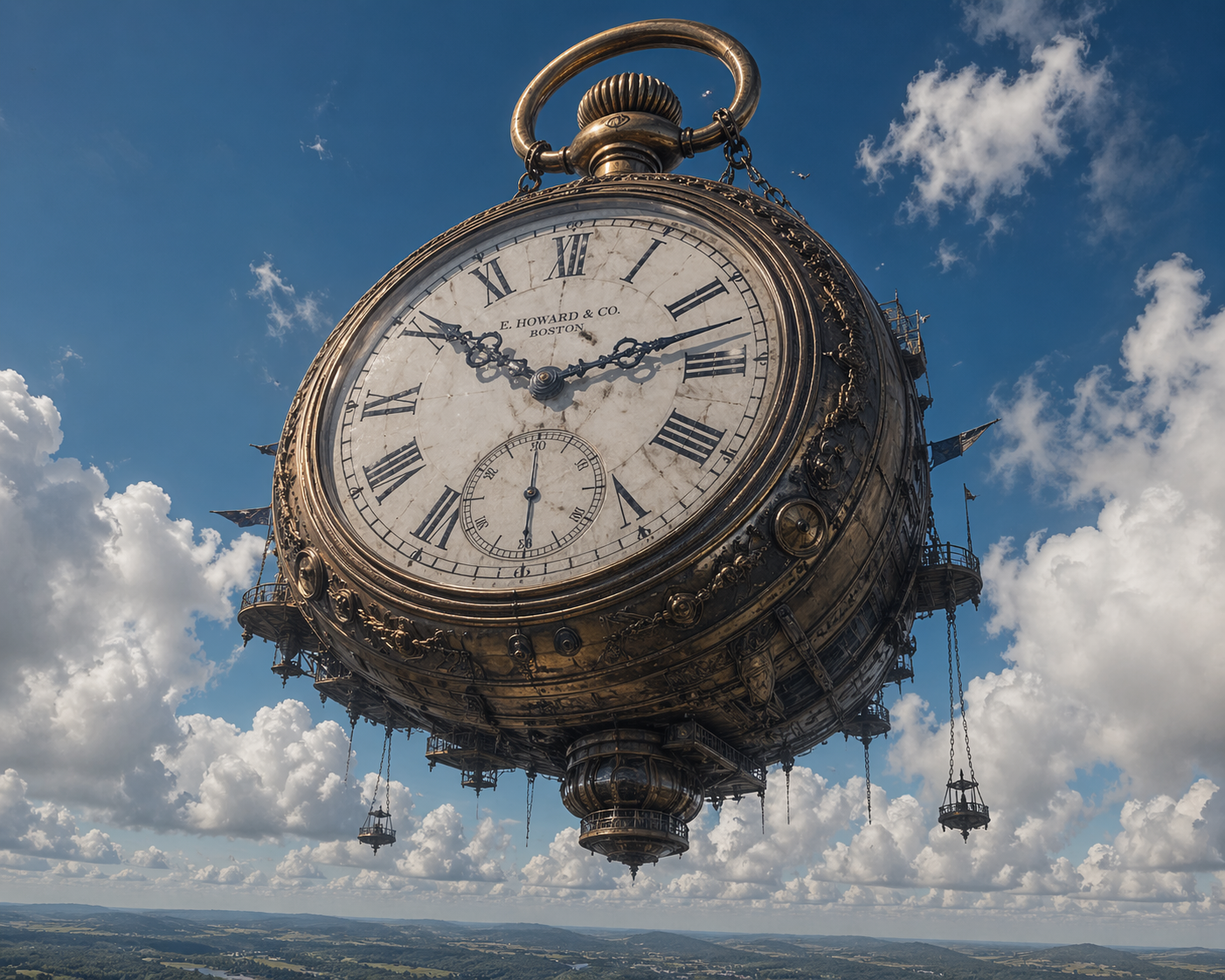
If you found a beautiful pocket watch washed up on the beach, you would immediately distinguish it from shells, seaweed, and sand. Its perfectly round shape, intricate gears, inscribed Latin numbers, and polished brass surface would all speak of an artificial object, designed and constructed by a watchmaker. The appearance of design would suggest a designer.
William Paley is the most famous populariser of the Watchmaker argument, which suggests, by analogy, that just as we’d conclude the existence of a watchmaker if we found a watch, so we should conclude an intelligent Designer’s existence for the existence of nature. Nature has all the appearance of design: intricacy, beauty, and ingenuity. The Argument From Design (or teleological argument, from telos, meaning goal or point) has been broadly accepted by all kinds of cultures and religion, arguing for, at the very least, divine existence – without identifying who the God or gods may be.
That was until Charles Darwin. One way to imagine Darwin’s project is to see it as an extended explanation of how the appearance of design can be present without an actual designer. Darwinism argues that the intricacy, beauty, and marvels of the natural world are exactly what you’d expect in the struggle for survival. Life adapts and mutates; some adaptations provide a survival advantage; small changes are preserved in the progeny of a species. Give nature enough time (on the order of hundreds of millions of years), and the result is a natural world that looks like pocket-watches everywhere. But what you’re seeing is not actual design; you’re merely observing the visible result of random mutations that brought success in the struggle for survival. Biologists like Richard Dawkins make this argument at length, as he does in his book aptly titled The Blind Watchmaker. Nature is the watchmaker – but it has no intention, no pre-determined design, and no standard of beauty. Nature makes these natural watches, which is another way of saying, they make themselves in the competition for survival.
The Darwinistic explanation has a lot of explanatory power. It’s by far the best argument against the teleological argument that any culture has produced (and many have tried). Its cleverness is one reason why it’s become the biological paradigm of our age. Every creationist argument that points to the intricacy, beauty, and ingenuity of nature is simply answered with, “Yes, it is truly a wonder how cleverly and beautifully life can adapt over millions of years, its end-state appearing like an artwork that was designed.”
Darwinism appeared unassailable for decades. Even the arguments of men like Michael Behe, who pointed out the irreducible complexity in the cell, were met with the same Darwinistic tropes. “Enough time and enough failed adaptations will eventually bring about a successful organism, even that which appears irreducibly complex”.
That was until physics and cosmology began discovering the physical constants and laws of the known cosmos. They found that constants like the speed of light, Planck’s constant, the gravitational constant, the electromagnetic constant, mass of protons, mass of electrons, strong and weak nuclear forces, and several others all needed to be in an extremely fine-tuned balance. Alterations by even a fraction of a percent of any of them would have resulted in no universe at all, or certainly no chemical life.
So exquisite was this balance, that it came to be known as “Fine Tuned Universe” hypothesis. Even atheist physicist Stephen Hawking said, “The remarkable fact is that the values of these numbers seem to have been very finely adjusted to make possible the development of life.” Christopher Hitchens, in conversation with Doug Wilson remarked that it was the Fine Tuned Universe hypothesis that gave him and fellow atheist Richard Dawkins the most pause, and the most difficulty.
It’s one thing to say that living organisms that mutate can eventually produce the appearance of design after millions of years. But what do you do if there is the appearance of design at the very beginning of the universe? Physical constants do not slowly evolve. The speed of light has not steadily mutated to provide life with a survival advantage. Either these constants were finely tuned to enable life, or we have to find another, even grander form of randomness to explain them. Sir Fred Hoyle, the agnostic physicist said, “A common sense interpretation of the facts suggests that a superintellect has monkeyed with physics, as well as with chemistry and biology, and that there are no blind forces worth speaking about in nature.”
So how do atheistic philosophers and scientists answer this? One approach is that of physicist Martin Rees: “Some would argue that this fine-tuning of the universe, which seems so providential, is nothing to be surprised about, since we could not exist otherwise.” Thus, we should not be surprised that the universe is fine-tuned for life, since we are here observing that it is.
But this is a logical fallacy known as non causa pro causa, wrongly identifying the cause of an event. It is best refuted with John Leslie’s Firing Squad:
“You face 100 expert marksmen. They all fire and all miss. You say, “I shouldn’t be surprised — if they hadn’t missed, I wouldn’t be here to be surprised.” But this is absurd. Your survival still demands an explanation (Were they ordered to miss? Did you hallucinate? Is this a dream?). The mere fact that you could only notice their missing if they missed does not explain why they missed.”
If the chances of all the constants of the universe having been correct for life to occur is around 1 in 10229 , the mere fact that we are here to observe the universe does not explain why we are here.
Most committed atheists have instead resorted to the multiverse theory. This is essentially the time and chance factor multiplied by near infinity. If our universe looks finely tuned, it must be that there are, at least, 10229 universes out there, and ours happens to be the one where we hit the impossible lottery numbers, and life came to be. Of course, there is no evidence for other universes, except if you take the Fine-Tuning of our own universe as proof of other universes, which is simply begging the question. Physicist John Polkinghorne wrote, “Let us recognise these speculations for what they are. They are not physics, but in the strictest sense, metaphysics. There is no purely scientific reason to believe in an ensemble of universes.”
After nearly 170 years of believing that all the pocket-watches around us were made randomly by a blind watchmaker, the world is now confronted with a cosmic-sized watch, dangling in the heavens, that was there from the beginning.
Great article to forward to atheist friends, however, before I do, may I respectfully suggest the following edits:
“Yes, it is a truly a wonder how cleverly…..
So how do atheistic philosophers answer scientists answer this? – (confusing perhaps rephrase?)
Thanks for catching those!
Comments are closed.